






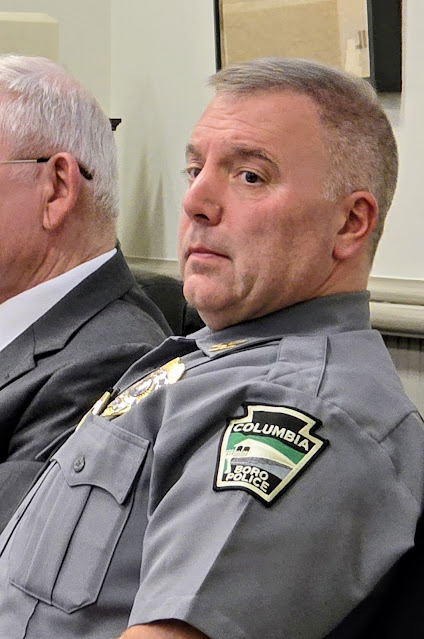
Columbia Borough is now living through a multi‑layered transparency crisis that has shaken resident confidence to its core. What began with the firing and banning of Chris Vera, expanded into contradictions from council leadership, secret internal investigations, and—most recently—the revelation that Chief/Interim Borough Manager Jack Brommer privately sent a police‑coverage proposal to Wrightsville Borough while publicly denying it existed.
This is not normal small‑town politics.
This is systemic breakdown.
🔥 PART I — The Mishandling of the Chris Vera Case
1. Vera Fired Abruptly From the Market House
Columbia Spy reported that at the March 27, 2025 Borough Council meeting, the firing of Market House Manager Chris Vera was a major topic. Borough officials cited “performance concerns.” Residents questioned the process and who was actually responsible.
2. Borough Issued a No‑Trespass Letter Against Him
Shortly afterward, Vera received an official Borough letter banning him from all borough property. LancasterOnline reported that the ban might be unconstitutional, raising legal concerns about why such an extreme measure was taken.
3. That Ban Was Later Quietly Rescinded
On December 22, 2025, the Borough formally reversed course, issuing a “Rescission of Letter of No Trespass,” restoring Vera’s right to enter borough property.
4. Journalists Had to File RTKs to Expose the Truth
LNP Media Group filed an extensive Right‑to‑Know request, seeking all internal documents about Vera’s firing. The Borough partially denied it, withholding key records under employment exemptions.
When a borough fights this hard to hide routine employment records, the public notices.
🔥 PART II — The “Secret Email” Denials & Contradictions
At a recent council meeting, when residents questioned the existence of a letter or internal communication:
- Council Heather Zink insisted there was no letter, even challenging residents:
“How would you even know if it existed?” - Then Chief/Interim Borough Manager Jack Brommer admitted there was an internal investigation, and that the Borough had investigated itself.
These two statements directly contradict each other.
Residents immediately recognized this as gaslighting by omission.
🔥 PART III — The Wrightsville Police Proposal Scandal
This is the scandal that turned distrust into outright disbelief.
1. A Resident Asked a Simple Question. Officials Denied Everything.
At the January 27, 2026 council meeting, resident Sharon Lintner asked whether Columbia Borough Police had submitted a written proposal to Wrightsville Borough for police coverage.
Here’s how officials responded:
- Council President Eric Kauffman: He was unaware of the proposal.
- Mayor Leo Lutz: Claimed there was “nothing official,” “no correspondence,” and “we didn’t even talk money.”
- Councilman Ethan Byers: Said “no formal discussion.”
- Councilman Kelly Murphy: Insisted it was “just a phone call.”
They all minimized or denied the existence of any proposal.
2. Columbia Spy Went to Wrightsville — and Found the Truth
Wrightsville officials confirmed:
- A written proposal DID exist
- A meeting between both boroughs HAD occurred
- Columbia Borough’s own police leadership had provided a formal policing services document
Lintner filed a Right‑to‑Know request with Wrightsville Borough. What she got back blew the lid off the cover‑up.
3. The Document Revealed a Full, Detailed Police Proposal
The proposal:
- Was on official Columbia Borough Police Department letterhead
- Was dated April 15, 2025
- Listed staffing, patrols, and service descriptions
- Provided a detailed per‑capita cost formula
- Was publicly discussed in Wrightsville on November 3, 2025
4. And the Cost? Nearly $900,000 a Year — Laughably Outrageous
Columbia PD used its 2025 police budget of $3,963,732, divided by its population, to calculate a per capita rate of $387.76 per resident. Applied to Wrightsville:
- Pop. 2,257 × $387.76 = $875,174.32 annually
Nearly $900k for a town of 2,200.
Wrightsville officials reportedly found the proposal staggeringly expensive.
5. Brommer Finally Acknowledged It — Barely
In February, after the documents surfaced, Chief/Manager Brommer admitted he “submitted the numbers,” but emphasized that “not all councilors knew about it.”
This is staggering.
The Chief — who is ALSO the Interim Borough Manager — sent a formal inter‑municipal policing proposal without informing his own council.
🔥 PART IV — What This Says About Leadership & Governance
1. The Chief/Manager Cannot Be Both Roles Transparently
Brommer is:
- The Chief of Police
- The Interim Borough Manager
- The soon‑to‑be full‑time Borough Manager
This means:
- He supervises himself
- He can approve his own departmental proposals
- He controls his own oversight
- He manages both the police department and the borough administrative apparatus
This structure is a conflict of interest by definition — and the Wrightsville proposal proved exactly why.
🔥 PART V — Why Residents No Longer Attend Meetings
Across Columbia Spy footage and ColumbiaPA.online editorials, one theme is constant:
Residents feel ignored, dismissed, or deceived.
Because:
- Officials deny what later turns out to be true
- Letters exist, then supposedly don’t, then reappear
- Internal investigations are done by the very people accused
- Major proposals are sent behind council’s back
- Residents must file RTKs with other municipalities to learn what their own borough is doing
- People who challenge the borough (like Vera) face bans, firings, and fear of retaliation
This is the opposite of transparent governance.
🛑 FINAL ANALYSIS: This Is Not a “Miscommunication.” It Is a Pattern.
A pattern of:
- Concealment
- Retaliation
- Denial
- Contradiction
- Self‑policing
- Withheld records
- And misleading public statements
A pattern that destroys public trust.
Residents aren’t staying home from meetings because they don’t care.
They’re staying home because they’ve learned their voices won’t change anything — that leadership has insulated itself from accountability.
Columbia Borough’s government must confront this reality:
Until transparency becomes the default, trust cannot return.
Until oversight is independent, investigations cannot be credible.
And until leaders stop denying facts that citizens later prove, residents will not participate.
Democracy cannot survive on confusion, secrecy, and self‑investigation.
It survives on truth, clarity, and public trust — three things Columbia’s government is rapidly running out of.