



EDITORIAL: It’s Time for Columbia to Turn the Page — Together
The past several weeks in Columbia has been dominated by one thing: the email saga. The questions, the confusion, the accusations, and the borough’s response have divided neighbors and strained trust across our community. Regardless of where anyone stands, we are now at the point where all of Columbia must face the same simple truth:
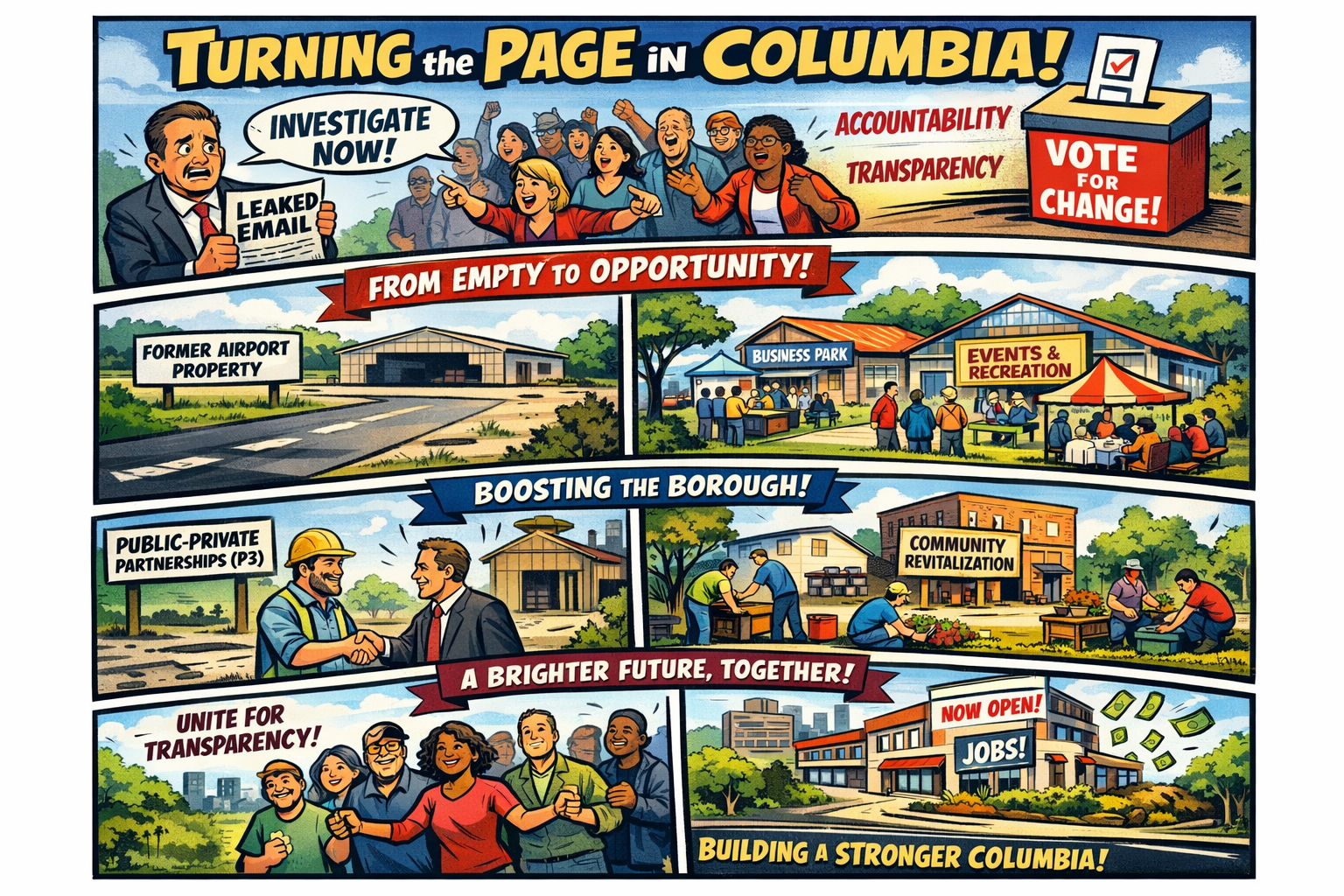
The email is public. It must be investigated. And the community deserves transparency — absolutely and without delay.
ColumbiaPa.Online has covered the Borough’s statements, including the cited use of a “Non‑Criminal Investigation Exemption” to deny an earlier request related to this matter.
Now that the email has entered the public sphere, the appropriate next steps are not optional — they are required. If our elected leadership chooses not to pursue a proper investigation, the remedy is equally clear: the voters must elect candidates who will. That is how representative government works, and transparency is the foundation it rests on.
But the purpose of this editorial is not to rehash conflict. It is to move us forward.
A Path Toward Healing: Transparency and Community First
Communities don’t grow when we dig trenches. Communities grow when we build bridges. And right now Columbia needs bridge‑building more than ever.
Transparency shouldn’t be a partisan issue. Accountability shouldn’t be controversial. And unity shouldn’t be conditional.
Our borough is at a moment where we can finally shift the conversation from what went wrong to what we can do together. That includes boosting economic development, repairing trust, and unlocking opportunities that have been overlooked for far too long.
Let’s start with the most promising, practical opportunity we have:
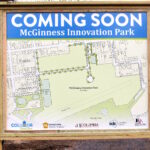
the redevelopment of the former airport property and other borough‑supported sites.
Columbia’s Untapped Asset: The Former Airport Property
Small communities across the country have transformed underused airport or airfield properties into local economic engines. Multiple national case studies show how such properties — even long‑inactive ones — can be turned into catalysts for growth.
For example:
- Mason City Municipal Airport (Iowa) revitalized its facility by embracing community events like monthly public gatherings that attracted pilots and travelers, driving local spending in hotels, restaurants, and small businesses. This demonstrates how even modest aviation‑related spaces can stimulate economic life when paired with community engagement.
- DuPage County Airport (Illinois) transformed from a simple grass strip into a high‑impact driver of local economic activity. It now generates a $1.5 billion annual impact thanks to diversified land use, including an industrial park and even a golf course on airport‑associated land.
These examples prove something important:
Airfield‑adjacent land, when strategically planned, can become one of the most valuable assets a small town possesses.
Columbia’s former airport property is no exception.
With the right plan — business incubators, light industrial development, aviation‑compatible recreation, community events, or mixed‑use commercial development — this site could:
- Attract new businesses
- Generate job growth
- Expand the tax base without raising taxes
- Create long‑term stability for the borough
But getting there requires leadership that is transparent, collaborative, and willing to partner with residents — not shut them out.
Other Borough-Supported Properties: A Missing Economic Link
Across rural America, small towns have succeeded when they build comprehensive development strategies, not piecemeal ones. Research from UNC’s School of Government highlights that community development is economic development, especially when long‑term planning replaces short‑term political decisions.
The most successful small municipalities:
- Encourage local entrepreneurship
- Revitalize blighted or underused properties
- Link redevelopment areas into a unified vision
- Align long‑term investments with generational benefits
Columbia can follow this model immediately by:
- Creating a master plan for all borough‑assisted development sites
- Prioritizing cohesive redevelopment rather than isolated projects
- Engaging residents early and often in planning processes
- Leveraging state, federal, and nonprofit grant opportunities
If everything is siloed, Columbia grows in fragments.
If everything is coordinated, Columbia grows strong.
How Boroughs With Little Money Generate Revenue — Without Raising Taxes
Rural communities across the country face the same problem Columbia faces: needs that outpace available funds. But the good news is that there are proven ways to generate revenue sustainably — without raising property taxes or burdening residents.
1. Public‑Private Partnerships (P3s)
Local governments can bring in private investment for infrastructure, facilities, redevelopment, or public‑use assets — including airport-adjacent land. These partnerships generate revenue streams while reducing borough costs.
2. Asset Monetization
Municipalities can lease land, buildings, or underused public resources to private sector partners. This creates steady income without selling public assets.
3. Economic Development Through Business Growth
Studies show that when small towns attract new business activity — especially through streamlined permitting, commercial construction, and broadband infrastructure upgrades — they increase revenue organically through expanded tax bases, not higher tax rates.
4. Diversifying Revenue Streams
Local governments that diversify their revenue using innovative programs, grants, technology, and efficiency improvements become more resilient and less dependent on traditional taxes.
5. Tourism, Events, and Creative Local Programming
Rural communities have revitalized themselves by hosting recurring events, launching cultural trails, and leveraging historic preservation — as seen in nationwide case studies from the NADO Research Foundation.
Moving Forward: Columbia Deserves the Next Chapter — Not the Last One
The email saga may have shaken trust, but it has also given us an opportunity — an unexpected chance to reset our expectations for transparency and leadership.
Here’s what ColumbiaPa.Online believes:
- Investigate fully.
- Make the findings public.
- Hold leaders accountable — at the ballot box if necessary.
- Refocus on economic growth, not political infighting.
- Use borough assets — especially the airport property — to generate real opportunity.
- Build revenue in smart, modern, community‑first ways.
- Bring our residents back into the decision‑making process.
Columbia is not broken.
Columbia is becoming.
But only if we choose progress over division and transparency over secrecy.
A Final Word to Our Readers
ColumbiaPa.Online is here to inform, engage, and unite — not divide.
We believe in accountability, but we also believe in a future where this town thrives economically, socially, and civically.
We can get there.
But we must do it together.