






Is Columbia’s 41‑Acre Airport Site a Goldmine? A Clear Look at What Developers Could Really Make
By ColumbiaPA.online Business Desk
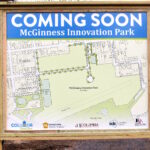
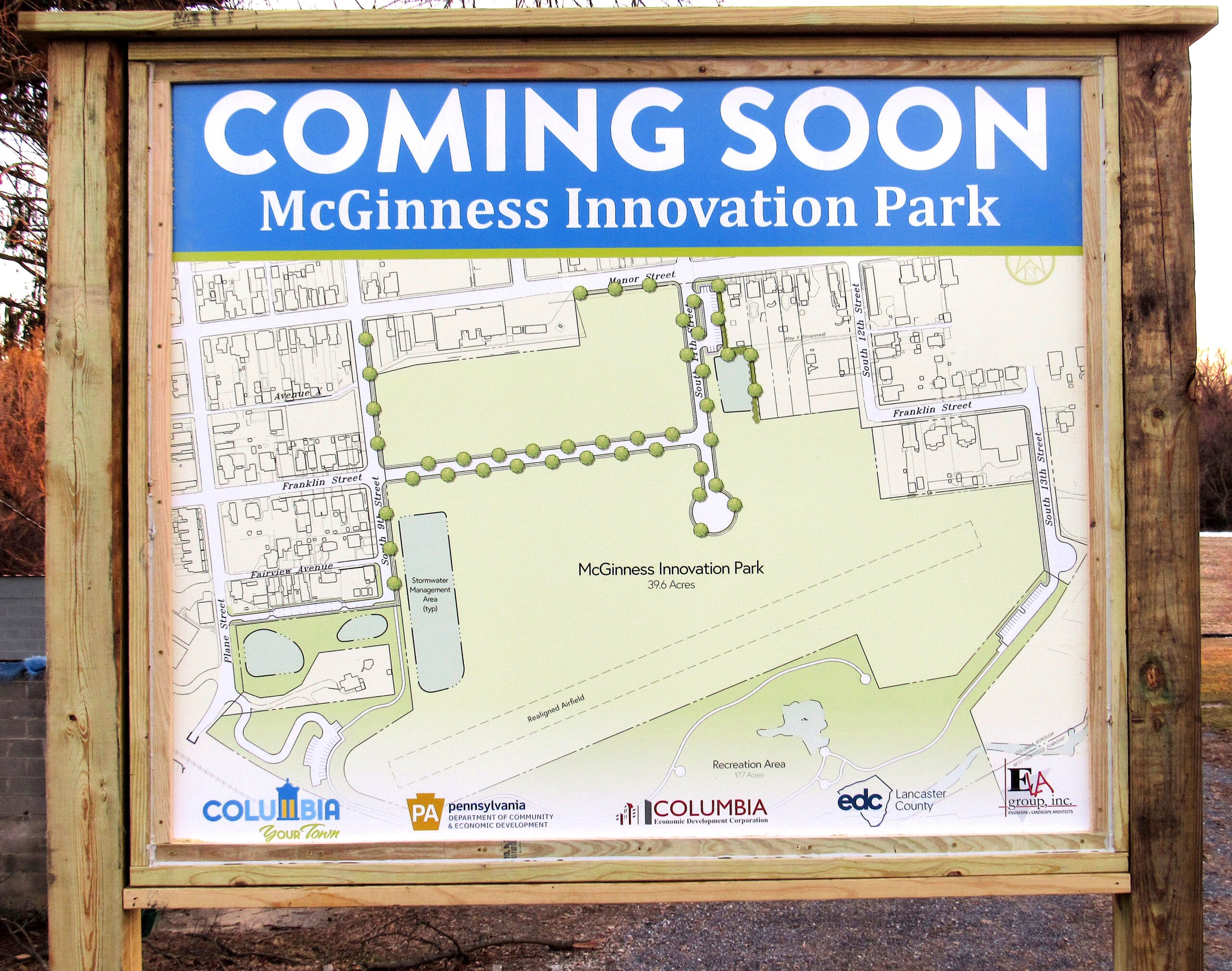
Columbia Borough is officially seeking a buyer for the 41‑acre former McGinness Airport property, a once‑idle tract that leaders now hope to transform into a major economic engine. The site—now branded McGinness Innovation Park—is being marketed as the largest developable parcel in the borough and the key to long‑term job creation and tax‑base growth. The minimum bid to acquire it: $6.2 million.
But is that price the right number? And more importantly—can a private developer actually make money there? We dug into the numbers, the construction costs, the rent markets, and the exit values to answer the question the whole town is really asking:
Is this a good deal, or an overpriced dream?
The Land: Pricing, Preparation, and Opportunity
The Borough purchased the property from the McGinness Family Trust after decades of underuse, then began a full site cleanup—removing debris, compacting soil, and preparing the land for commercial construction. Borough officials confirmed that roughly $2 million has already been spent on site preparation, supported by a $9 million Pennsylvania Business in Our Sites loan, with remaining funds still available for the future buyer to use.
The site is strategically located near both bridges on Route 462 and U.S. Route 30 and is zoned Light Business, allowing a wide range of commercial and light‑industrial uses. Borough leaders say the property could support a business park, small shops, restaurants, and other employment‑creating uses.
The minimum bid—$6.2 million—is based on the borough’s cost recovery, infrastructure investment, and the site’s unique development potential.
What the Market Says: Rents, Costs, and Cap Rates
To understand whether developers can profit, we analyzed Lancaster County commercial real estate data from 2024–2026.
Industrial Rents (the core of this project)
- Lancaster County’s average asking rent for industrial/warehouse property: ~$8.67/SF NNN.
- Many Class A listings reach $9.00–$12.95/SF NNN, especially newer or more specialized spaces.
Retail Pads (if included in the park)
- Retail spaces in Lancaster routinely lease for $15–$25/SF NNN, depending on frontage and traffic counts.
This means a mixed‑use plan could significantly raise blended rental income.
Construction Costs (2025–2026 real data)
- Core/Shell industrial construction: ~$85/SF average.
- Realistic total project cost: $115–$150/SF, once sitework, soft costs, contingency, and tenant improvements are included.
Industrial Cap Rates (valuation math)
- Pennsylvania industrial real estate trades around a 6.6% cap rate (average).
- Well‑leased, modern Class A properties may achieve 6.25%.
**So… Can a Developer Make Money?
A Straightforward Analysis**
We modeled the project using real market data, realistic construction budgets, and exit cap rates. The scenarios below assume a developer builds 350,000–500,000 square feet of light‑industrial/flex space (reasonable for 41 acres), at 95% stabilized occupancy.
We tested three development outcomes: Downside, Base Case, and Value‑Add.
1) Base Case: Solid but Not Spectacular Rents → Project Does NOT Pencil
Assumptions:
- 450,000 SF of buildings
- Rent: $9.75/SF NNN (slightly above Lancaster average)
- Construction cost: $135/SF
- Cap Rate: 6.6%
- Public support: None
Outcome:
- Total development cost: ~$69.99M
- Stabilized NOI: ~$3.96M
- Property value at sale (6.6% cap): ~$60.0M
- Profit: –$10.0M (negative 14.3%)
Conclusion: At normal Lancaster County rents, the project loses money.
Developers won’t pursue this without stronger rents or lower costs.
2) Value‑Add Case: Pre‑Leasing + Value‑Engineered Costs → Strong Profits
Assumptions:
- 450,000 SF
- Rent: $11.50/SF NNN (achievable with anchor tenants or specialty users)
- Lean construction: $115/SF
- Cap Rate: 6.25%
- Borough participation: $2M in infrastructure support
Outcome:
- Total cost: ~$58.54M
- NOI: ~$4.77M
- Exit value: ~$76.3M
- Profit: +$17.76M (approx. +30.3% margin)
Conclusion: Under the right conditions, the site becomes a high‑performing investment.
3) Downside Case: Lower Rents + High Construction Costs → Red Flags
Assumptions:
- 350,000 SF
- Rent: $9.00/SF NNN
- Construction: $150/SF
- Cap Rate: 7.0%
- No public support
Outcome:
- Total cost: ~$61.33M
- Exit value: ~$40.61M
- Profit: –$20.71M (negative 33.8%)
Conclusion: Without premium rents or cost controls, developers would avoid this scenario entirely.
The Break‑Even Rent: The Magic Number
Using verified inputs, the break‑even rent for a typical developer is:
≈ $11.37/SF NNN (no public support, mid‑range costs)
Drops to ≈ $11.05/SF with $2M in borough support
Drops to ≈ $10.56/SF with $5M support
Drops to ≈ $9.84/SF if construction is kept to $115/SF
Since Lancaster’s top‑tier leases can reach $10.95–$12.95/SF, these numbers are feasible but require intentional planning.
Bottom Line: Is the McGinness Site a Good Deal?
YES—if the developer:
- Pre‑leases to one or two anchor tenants at $11–$12/SF NNN
- Controls construction to ~$115/SF (lean, modern light‑industrial spec)
- Uses available borough infrastructure funds to offset site prep
- Adds one or two higher‑rent retail pads along Manor Street to lift revenue
NO—if the developer:
- Assumes standard $8.50–$9.00 rents
- Uses heavy, expensive building specs
- Attempts to build speculatively without anchor tenants
- Does not secure any public participation
What This Means for Columbia
The McGinness Innovation Park is not “easy money”—but it can be a highly profitable regional development if the right kind of project is built, and if the borough and developer collaborate on sitework, infrastructure, and tenant attraction.
This is precisely why the Borough is requiring bidders to submit detailed plans, financial strength documentation, and community benefit proposals, not just a check.
With the right strategy, Columbia could see:
- Modern employment centers
- Light industrial and technology businesses
- Retail and service amenities
- New tax revenues
- Job creation for residents
- Long‑term revitalization momentum
And developers could see double‑digit returns and a signature campus in one of Lancaster County’s most strategically located river towns.
Want More Deep‑Dive Coverage?
ColumbiaPA.online will continue tracking the bid process from March 30 to May 15 and will publish summaries of all publicly disclosed proposals, interviews with key stakeholders, and updates on the final award decision.
Stay tuned—this project could reshape Columbia’s economic future.